Looking for Sean McLachlan? He mostly hangs out on the Civil War Horror blog these days, but feel free to nose around this blog for some fun older posts!

You can also find him on his Twitter feed and Facebook page.


Showing posts with label travel writing. Show all posts

Saturday, 24 November 2012

New travel series on Iraq


Back from the dead? Well, not really. I still get a fair number of hits on some of the posts here but I don't have any immediate plans to revive this blog. I did want to mention that I've started a new series for Gadling, which is about traveling in Iraq. I spent 17 days in the country last month and I'm writing a long series about my intense yet mostly positive experiences there. It's called Destination: Iraq. Check it out!

And if you do want to read a blog by yours truly, check out my Civil War blog.

Wednesday, 25 August 2010

Hiking the East Highland Way

Observant readers of this blog will notice a new box on the margins. I'm currently writing a series for Gadling on hiking the East Highland Way, a 76-mile route through some amazing scenery. Check out the link for stories about my visits to Pictish forts, medieval castles, and beautiful countryside, along with my blunt opinion of haggis!

Last year I hiked the Hadrian's Wall Path. While that was a lot of fun the East Highland Way was more challenging. I'm not sure what my long-distance hike will be next year, but I'm sure it will be in Scotland! The far north near Cape Wrath, which is even more remote than the area I went to, looking very promising.

Wednesday, 23 June 2010

Traveling through Africa with Border Jumpers

A very cool blog contacted me last week. It's called Border Jumpers and it's pretty much what it says on the tin. Bernard Pollack and Danielle Nierenberg are on a mission to visit nearly every country in Africa, writing about their experiences with a special focus on community groups, NGOs, and local people. Sounds a bit like the Africa Heartbeat project I've covered here before.

They started in Addis Ababa last year and so far have made it to an impressive list of nations. They've talked with conservationist farmers in Ghana and written about using traditional crops to fight climate change in Zimbabwe. These are just two of the dozens of projects they've covered.

As I discovered on my recent trip through Ethiopia and Somaliland, Africa thrusts beauty and poverty at you simultaneously. Just look at the above photo, courtesy of Border Jumpers, of a palm oil processing center. It's little more than a bunch of grotty drums and a lot of hot steam in an already hot climate. Yet the woman standing in front radiates grace, beauty, and pride.

Border Jumpers, Africa Heartbeat, and I are headed the same direction with our writing. We're experienced travelers who have learned that the world is not the big, scary place TV tells us it is. It's big alright, but filled with intelligent, kind people doing all sorts of interesting things. The single most important thing a travel writer can do is communicate that simple truth to as many people as possible. So check out those sites for some uplifting reading, and some facts about Africa the mainstream media don't bother to cover.

Wednesday, 19 May 2010

Does being a travel writer affect the way you travel?

On my writing blog I recently posted about celebrating a year working for Gadling, the most popular travel blog on the Internet. This got me thinking about how being a travel writer affects the way I travel. I also asked some of my fellow Gadlingers.

Like any pro, Tom Johansmeyer is always on the lookout for story ideas. He recalls a recent trip to Norwich, VT, to visit family.

"We stopped at a rest station along the way, and I saw a flier for “The Strolling of the Heifers,” which is some local event. My first thought: I can use that! Even when I’m on the road and not looking for anything, I can’t help noticing opportunities, and recreation becomes work, which itself is recreation."

I do this too. Even walking in my barrio in Madrid I end up with a handful of fliers about cultural events and interesting shops, and any trip gives me far more leads than I can possibly follow. The constant search for story ideas becomes a compulsion for both of us.

"When I ride the bus from New York to Pennsylvania to see my son, I’ll get ideas (“Five Ways to Cope with Winter Bus Travel”) or run into situations worth covering (e.g., poor service). I even did a video review on a Port Authority hot dog," Johansmeyer says.

Annie Scott says being on the job makes her more active and aware, "I go out and see things even when jet lagged. I get up and try the breakfast at the hotel instead of sleeping. I try new foods that look scary. I'm less afraid to ask silly questions and explore inappropriate places because I know that my curiosity is validated; it's a professional tool."

Willy Volk agrees.

"I think I look around a lot more, and notice what might be interesting to OTHER people, as well as what is interesting just to me," he says.

Like them, when I'm on assignment I keep my reader in mind. Who that reader is depends on the market I'm writing for. The demographic for British Heritage is very different than Gadling. I'm always asking myself, "What are my readers interested in? What do they think is important?"

"It's our duty to go one step beyond the realm of the average tourist," says David Farley. "It's our job to gain insights about the place that can sometimes only come from a more immersed experience. Part of our job--or, at least, my job--is as reporter and fact-gatherer, which isn't always something the average traveler does. For that reason, when I'm on assignment (which is about 99 percent of the time I'm traveling), I always arrive in a place with a small cadre of friends of friends waiting for me. I also schedule interviews with people who will help inform my story, which is something I wouldn't do if I were just a tourist. Travel writing is a job, not a vacation, so when I'm on the road, it's a lot of fun but at times it's also a bit exhausting."

"I notice nitpicky things," says Laurel K. Miller, "like when hotel rooms are lacking enough electrical outlets/if they're in lame locations, if the bathroom doors open into the toilet, etc."

I get this way too, but only when I'm writing reviews of the actual place. Then I can get really nitpicky. The more expensive the place, the less forgiving I am.

Friends sometimes ask me if working on the road kills my enjoyment of travel. It never has, and it doesn't seem to bother David Farley either.

"Because I'm forced to interview people and cross a certain threshold that I wouldn't normally do as a 'tourist,' I end up having a more enriching travel experience. Then I try to shift that enthusiasm into my writing about the experience," Farley says.

"I actually think travel would be rather boring for me if I weren’t a blogger," Johansmeyer agrees.

But Miller says it's made her "jaded."

"While I'm grateful every day for this career, I no longer feel the need to take photos of every beautiful beach or sunset, and it's harder for me to be impressed by locations/service/food/accommodations," she says.

Miller also finds hopping back and forth between travel and regular life a bit strange.

"While I actually enjoy mixing up high end assignments with "real" travel, as I'm a broke-ass dirtbag journalist, I struggle with the schizoid existence of living large one day, and dealing with drunken idiots in bunkbeds the next. Even more bizarre, I wait tables and do other random jobs when I'm at home, to supplement my writing. I've actually had moments where I've worked at a restaurant one night, hopped a plane on assignment the following day, and later that night found myself dining at an extremely high end restaurant. I'll actually have to suppress the urge to bus a table out of habit," she says.

Having ridden across a desert on a crowded African bus one day, then had a picnic in an English park with my kid and his friends less than a week later, I can sympathize with the "schizoid existence" comment!

While it seems the consensus is that being travel writers affects how we travel, there are times when it doesn't affect me at all. These tend to be on my more adventurous trips, such as traveling in Ethiopia or Somaliland, or hiking Hadrian's Wall. I'm doing those trips for me, and even though I write them up for Gadling they are from a personal perspective. When you read my newsy bits for Gadling you're just getting facts. When you read my features, especially my series, you're getting me. So I guess I have a certain protectiveness with my dream trips. When I finally get to The Gambia to do my long-planned river journey, I will of course write it up for Gadling and maybe some other markets, but the trip will be all mine.

Photo courtesy Leo Stolpe. It shows me taking notes in the painted caves of Laas Geel in Somaliland. Yes, that's a Gadling shirt I'm wearing.

Wednesday, 5 May 2010

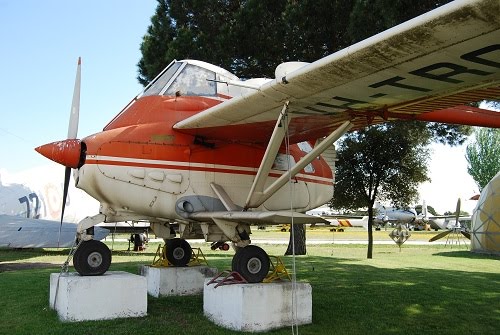
The strange little airplane that became a movie star

Does this little plane look familiar? Perhaps it would look more familiar all banged up and flying over the Australian outback with Mel Gibson in it? That's right, it featured in Mad Max: Beyond Thunderdome!

Introducing the Transavia PL-12 Airtruk, which in the first scene of the movie flies down out of the skies to attack Max as he's driving his disabled police car across the desert with the help of a team of camels. Jedediah the Pilot, played by Bruce Spence, knocks Max off the top of the car and steals the vehicle. Later in the movie Jedediah and Max team up. The pilot flies a group of kids to safety with Tina Turner and a bunch of leather daddies in hot pursuit. Max clears the way for them in a cool fight scene but is left behind, doomed to be the eternal outsider.

The PL-12 was introduced by the Australian company Transavia in 1966 for bush work such as search and rescue, ambulance duty, and agriculture and is a compact, highly maneuverable vehicle perfect for post-apocalyptic hijinks. It has a maximum speed of 195 km/hr, is 6.35 meters long, 2.79 meters high, with a wingspan of 11.98 meters.

I've heard rumors that they're making another in the Mad Max series. I hope that's true, and I hope we get to see Jedediah the Pilot make a reappearance. He was always my favorite character. Hey Bruce Spence, if you happen to be googling yourself (no shame there, I do it all the time) could you tell us your memories of working with this cool plane?

Coming up tomorrow: helicopters and balloons!

Saturday, 1 May 2010

Missing Ethiopia

I've been back from Africa for a bit more than a month now and have just finished my Gadling series on travel in Ethiopia. Now I'm feeling some serious post-travel restlessness. This is common enough. A Swedish photojournalist I traveled around Somaliland with is feeling the same thing.

When the going gets tough, the traveler gets going! Now that the weather is getting nice here in Spain I'll be doing some hikes in the mountains, plus possible trips to Toledo or other interesting spots. I'll also be headed to Segovia, a beautiful medieval walled city not far from Madrid.

Speaking of beautiful medieval walled cities, I'm in the early planning stages of a two-month trip to Harar, Ethiopia. I spent some weeks there during my Ethiopia trip and totally fell in love with the people and history. There's an entire library of books that can be written on Harar, and I want to write at least one of them.

Looks like I have a travel bug that just won't die.

Monday, 26 April 2010

Two ways to drive across Africa

My two months of travel in Ethiopia was an epic trip, but it was nothing next to the African voyages of some people I know.

Previously on this blog I've mentioned my friend Thomas Tomczyk, who is motorcycling across Africa. He started in South Africa late last year and is now. . .I'm not sure where. When I was in Ethiopia he emailed me from Kenya, but he's since dropped off the map. I'm sure he's all right, though. He's like me, with a talent for getting into dodgy situations and then getting out of them.

Thomas' website, Africa Heartbeat, contains his stories and pictures of various NGOs and charitable projects he's covered along the way. His latest article is about Tunaweza ("Yes we can") a group of handicapped musicians in Tanzania who are pulling down barriers not only for handicapped people, but between religions--the members are both Muslim and Christian.

Hopefully he'll get in touch soon because I'd like to hook up with him later this year when he passes through the Sahara. Nothing like a reunion with an old friend in a scorching desert in summertime.

When Almudena and I were relaxing with a drink in a hotel garden in Gondar, Ethiopia, we met a South African couple who are driving around the coast of Africa. Steve Lorimer and Roxy Harvey converted a British Army truck into a cushy living space and set out to circumnavigate Africa from Morocco down the west coast to South Africa and then up the east coast, around the north and back to Morocco. Their website OverAfrica recounts this 25,000 km journey. They've had some tough spots, with breakdowns both mechanical and physical, but their journey has been mostly positive. I was especially interested in their account of The Gambia, where I plan to go next, and Namibia, which is also high on my list. Their site also gives lots of advice for doing your own road trip across Africa.

All this is making me want to hit the road again. . .

Thursday, 22 April 2010

Settling down in Madrid

After two months in Ethiopia and Somaliland, and ten days in Oxford, I'm finally back home in Madrid. Actually I've been back for a couple of weeks but things got a bit unsettled when Almudena got stranded in England due to the volcano, so it's only now that I feel I'm settling.

I won't be doing any traveling until late June, when we head back to Oxford. I was planning on going to the Italian army archives in May, but a contact in Rome tells me I have to apply three months in advance! Now I'm planning to go in September.

So how will this grizzled old traveler deal with not being on the road for two whole months? Well, I have a lot of book writing to do, plus finishing up my series of travel articles on Ethiopia, plus keeping up with this blog and my writing blog. I'll also be enjoying Madrid's nightlife, hiking, and literary scene. So stay tuned, I may be at home, but I can still explore!

Coming next: two adventurous ways to cross Africa!

Photo of Plaza de Cibeles courtesy Wikimedia Commons.

Wednesday, 14 April 2010

Passing through Oxford

I'm finally back in Madrid after more than two months on the road. I spent most of that time in Ethiopia and Somaliland working on a book on the Battle of Adowa. My series of articles about travel in Ethiopia has already started on Gadling and at the end of the month I'll start one on Somaliland.

Before settling back in Madrid the family and I spent ten days in Oxford. Almudena was collaborating with the astronomy department while I did research at the Bodleian library for my book. Julián got to see his English friends and go to camp over the Easter break. We visited the Pitt-Rivers and Natural History museums (his favorites, especially the dinosaurs) and climbed trees but sadly he didn't reacquire the English accent he had last year.

We love Oxford and spent six months here last year. There's always so much going on here and we have a good circle of friends. We had a whirlwind social schedule, including a stroll with friends through Magdalen College gardens to take these photos, and managed to pack in a fair amount of work too, plus a traditional Sunday roast at our local pub. I even managed to go to the Odyssey 2010 f/sf/h convention.

Sadly, our trip was all too short, but we'll be back in the summer for a couple of months. In the meantime I'm planning on hiking in the mountains near Madrid, remembering my Spanish as I forget my Amharic, writing lots, and spending a week in Rome at the national archives.

Friday, 2 April 2010

The travel bug that just won't die

Sorry for the long silence, but if you're a regular reader of this blog or any of my other social media outlets like Facebook or Twitter, you know I've been in Ethiopia and Somaliland for the past two months. Besides writing, my greatest love is travel. I previously posted about my travel year of 2009, which included a lot of shuttling back and forth between Spain, England, and Missouri, plus a hike across England along Hadrian's Wall and a short trip to Holland. Fun stuff, but nothing truly adventurous.

This year started well with some adventure travel. Thanks to two of my publishers, I had the money to go to the Horn of Africa, a place I've always dreamed of visiting. When I was ten I read a National Geographic article about the monastery at Debre Damo, a medieval Ethiopian monastery on top of a cliff. The only way to get there is to climb up a dodgy-looking leather rope. I thought that was the coolest thing ever and thirty years later I finally got to do it!

Almudena joined me for the first three weeks and we celebrated our tenth anniversary in Ethiopia. We did the popular historic northern loop, taking in ancient sites such as the monasteries on Lake Tana, Gondar, Axum, and Lalibela. Then she went home and I headed east to the medieval walled city of Harar and further on to Somaliland, an unrecognized state that comprises the northern third of what used to be Somalia. It was cool to visit "Somalia" and find it peaceful and friendly, but my favorite place by far was Harar. There's a special feel to walled cities that I've noticed in Damascus, Jerusalem, and Segovia. They comprise their own separate worlds, and their inhabitants are very aware of their history and culture.

So is my travel bug satiated? On the contrary, it's just woken up! I'm off to Italy in May, and hopefully The Gambia this autumn. Also, I'm going to try to convince my publishers to send me back to Ethiopia next year. I made lots of friends in Harar and I'd like to visit soon.

I'm writing a series of travel articles about Ethiopia for Gadling, and when that's done in about a month I'll do a series on Somaliland. Plus I intend to get back to blogging here on a regular basis. The Internet connection in Ethiopia was terrible. Most of the country was on dialup! Stay tuned.

Wednesday, 3 February 2010

What to read when you're on the road?

I've been nattering on about my upcoming trip to Ethiopia for some time now, but with less than a week to go, I'm busy getting sorted. One vital bit of travel gear requires serious thought--what to read?

Since I'm writing a book on the Battle of Adwa for Osprey Publishing, I'll be bringing a map of the battlefield and photocopies from Berkeley's excellent but sadly out-of-print 1935 volume The campaign of Adowa and the rise of Menelik, as well Marcus's A History of Ethiopia. These are essential for work, but what do I bring for pleasure?

The ideal travel novel should be compact, mass market size rather than trade paperback, thick so that it will last a while, engaging but not too dense. It should be a classic or current bestseller so that I can ditch it with the confidence that I can get another copy ten years from now if I want to.

After much searching through the chaos that is my personal library I've settled on The Reprieve by Jean-Paul Sartre. It's a mass market paperback (check), 345 pages of small print (check), intellectual but not obtuse (check), and since it's by Sartre I'll never have trouble finding another copy (check).

Now I need to find a hotel in Addis Ababa. . .

Image of Adwa tapestry courtesy Joshua Sherurcij via Wikimedia Commons.

Saturday, 9 January 2010

My first week on Twitter: a travel writer's perspective

I finally broke down and got a Twitter account (@WriterSean). I've been slow to get into the whole technology thing, despite being a cybercommuting writer. I didn't get my first mobile phone until two years ago, and then it was a slippery slope of personal blogging, getting a job at the world's largest travel blog, getting an account on Facebook, and now this!

I've been on Twitter exactly a week. I've done 52 tweets, am following 113 people, have 95 followers, and have been listed ten times. I have no idea of the significance of all this and I don't really care.

I got onto Twitter for two reasons: to give my novel's fanpage a higher profile in preparation for the contest it's a finalist in, and to network with other writers. As far as the first reason goes, I've only gotten one more fan from my first week on Twitter--a Missouri history writer I'm glad to meet. Of course it takes time to build a following, so I'll have to wait and see how well Twitter can be used as a promotional tool. There's a fine line between self-promotion and spamming; I have to tread carefully.

The second reason, networking, has succeeded beyond my wildest expectations. I've met tons of interesting writers. Most of them are travel writers and bloggers who found me because of my links with Gadling. Their advice and retweets have given me leads to three different stories already!

So all in all I think Twitter is worth the time if you have a specific reason for using it. If you just want to blab with friends and strangers there are better outlets for that. My wife, for example, is an astronomer. She doesn't need to network through Twitter because the astronomy community is small enough that everyone pretty much knows everyone else and they have their own networking communities. She talks to distant friends on Facebook, her chosen timewaster, so she doesn't need to add Twitter. For writers, however, Twitter is fast becoming indispensable.

Thursday, 24 December 2009

Christmas in Swaziland

Like I mentioned in my last post, my friend Thomas Tomczyk is riding a motorcycle across Africa as part of his Africa Heart Beat Project. He started out in Johannesburg, broke down in a shanty town 25 km into his journey, got his bike fixed, and is now on his way.

Right now he's in Swaziland, a small country nestled between South Africa and Mozambique. Actually, he may be in Mozambique by now, or somewhere else entirely. The last I heard he was in Swaziland. He recently posted an interesting article about animal conservation there and there are more articles to come as he will be featuring a different project for every country he visits.

You can follow Thomas' journey on his website and Facebook page, and here of course!

I'm off on an adventure of my own soon. From Feb. 9-March 27 I'll be in Ethiopia working on a book and a series of articles for Gadling. Almudena will be coming for part of the trip so we can celebrate our tenth anniversary!

I'm going to get back to studying the map of Ethiopia. Merry Christmas, Thomas, wherever you are!

Monday, 30 November 2009

Riding across Africa on a motorcycle

OK, I'm officially jealous.

I've done a lot of adventure travel in my day but I've been outclassed as an adventure traveler by an old friend of mine.

Thomas Tomczyk has just started out on a motorcycle tour of Africa, starting in South Africa and passing through 22 countries before ending up in Spain.

He says that he's past the stage of travel for travel's sake (I know the feeling) and so he's set up Africa Heart Beat, an online project to showcase various innovative NGOs he meets on the way. I've already blogged about his project here for Gadling, as well as the array of gear he's taking along to keep in touch with his Facebook page, his blog, and his YouTube channel.

Thomas is a professional writer and photographer, so you can expect some good stuff coming out of Africa for the next eight months.

I'm looking forward to hearing his insights on such projects as an AIDS theater group in Botswana, and a Muslim-Christian vocational center in Mali. I'm also hatching a plan to meet him in May or June of 2010, probably in Niger, Mauritania, or Western Sahara. Stay tuned. . .

Friday, 25 September 2009

What have I been doing?

OK, so I spend six months in Oxford and I barely blog about it. Sorry folks, but I got a bit distracted by the real ales, beautiful countryside, and watching my kid become bilingual.

I did get a fair amount done, however, and most of my experiences ended up on Gadling. As you can see from this picture, I hiked the length of Hadrian's Wall. I started out the day after my 40th birthday as sort of a midlife crisis. I figured walking 84 miles across England would be a nice way of celebrating my imminent decrepitude. I wrote a whole series about it for Gadling.

I also visited Avebury, which got written up, along with a friend's photos, as my 101st post for Gadling. I've also ranted about Americans hiding behind the Canadian flag, studying at Oxford, medieval churches and lost villages, and Alien Big Cats. Plus a whole bunch more. So yeah, I've been busy on the blogosphere.

So what's coming up in the next month on Gadling? A tour of Jesse James sights in Missouri, and a weekend in St. Louis. What's coming up on this blog? More musings about life in Oxford and what it's like to divide your time between three different countries. Stay tuned.

Saturday, 8 August 2009

Ichthyoelectroanalgesia!

A few weeks ago a fellow writer invited me to tag along to a talk at Oxford University Press about the Oxford English Dictionary, the most complete English dictionary in the world. One of the editors told us about how they put the dictionary together and all the work that goes into it. They have hundreds of readers around the world who scour through newspapers, magazines, and books looking for new words or new uses for old ones. An interesting detail was that the editors reject the majority of words people send in because they are too new, too rare, too regional, or just plain misused.

I gave them a word that probably will get rejected. Ichthyoelectroanalgesia! If you know your Classical languages, you know this means using an electric fish as a pain reliever. I came across the word in an archaeology article about old Roman and Parthian medical recipes, including one that involved pressing an area of your body that's giving you trouble against an electric fish. Apparently the low charge will relieve the pain. No, I haven't tried it.

This word stuck with me for a couple of years until I got swept up in the zine movement of the mid Nineties. Actually it started way before that, so I was hitting the second wave. Anyway, I produced my own zine dedicated to travel and archaeology and called it, you guessed it, Ichthyoelectroanalgesia. I only did four issues before I went on to other things, but I had a distribution of about two hundred and met lots of interesting people through the mail, including some I still correspond with.

I Googled my beloved word and found that two archives have copies of my zine. I've passed into zine history! One is for science fiction fanzines, which is strange since mine wasn't an sf zine, but I did trade with some sf fanzines so maybe that's where they got it from.

I'm also very proud I got to stump an editor at the OED with a word. :-)

Friday, 15 May 2009

Posting on Gadling

Hi everyone. Yeah, it's been two weeks since I posted on this blog. I've been pretty busy with various writing projects, including a new gig as a travel blogger on Gadling. I just started yesterday and should have a post or two on there every day from now on. As an introduction they sent me a bunch of interview questions and posted the interview here. They didn't use them all, so here's the rest of them. It's been so long since I posted you probably need to be reminded who I am anyway.

Favorite travel author? Sir Richard Francis Burton. He was an adventurer in the nineteenth century and helped discover the source of the Nile. Burton was able to pick up a language in only a few days and learned more than twenty in his lifetime. Unusually for English travelers of his day, he had a real sympathy and understanding of the African, Asian, Arab, and South American cultures he explored.

You may become the leader of any country in the world. What country and why? How would you rule? The United States because I’d have the most potential to make a change in the world. Hopefully I would get to rule as an absolute dictator so I could force a switch over to renewable energy and say goodbye to Middle East politics forever.

Person you’d most like to interview for Gadling? Sir Ranulph Fiennes, the adventurer.

Favorite tourist trap? The pyramids in Egypt. They’ve been a tourist trap since the days of Herodotus, but they’re so stunning it just doesn’t matter.

Hotel, hostel, or other? Couch surfing with friends.

Dream travel destination? Ethiopia. I’ll be going there in early 2010, so keep an eye out for my trip report!

Most remote corner of the globe you’ve visited? The border of Pakistan and Afghanistan (on the Pakistani side!). Sadly, that's Taliban territory now, so I guess I won't be seeing it again.

The ideal vacation is... me, a small backpack, a strange country, and no guidebook.

The most unusual food I’ve ever eaten is... Fried eel, in Denmark. Oh, and the various mystery meats I’ve had in some of the more remote countries I’ve visited. Best not to dwell on that too much.

Where do you hide your emergency cash? This is a family website so I better not say.

Leeches or mosquitoes? Mosquitoes. They’re harder to avoid and carry more diseases.

Favorite foreign dish? Restaurant? Pretty much anything Ethiopian. Currently my favorite restaurant is Merkato Ethiopian Restaurant at 193 Caledonian Rd., London. The owner brews his own tej, an Ethiopian mead or honey wine. It’s delicious, as is his cooking!

Worst place to catch a stomach bug? Anywhere is the worst place when it’s happening to you. The worst place I caught one was Cuzco in Peru. A beautiful city that I saw nothing of for my first two days staying there. That time in Allahabad, India, was pretty rotten too.

Solo traveler or group traveler? Solo is my preference, but one of the reasons I married my wife is because she’s one of the few people I can travel with for long periods of time without wanting to kill. She also found me ginger ale to settle my stomach when I was sick in Cuzco. Any woman who can find ginger ale in Peru at a moment’s notice is a keeper.

Connected or disconnected (re: phones, computer)? When I’m at home I’m way too connected. When I’m on the road I want to be totally disconnected.

Favorite music to listen to while traveling? None. I want to hear the sounds of the place I’m in.

First culture shock experience? When I was sixteen I was an exchange student in Denmark. My host family owned a farm. I was jetlagged and disoriented when I got there, and the first thing that happened was I discovered there’s a nasty variety of stinging grass in Denmark. The second thing I discovered was that the Danes serve fried eel as a delicacy. Then the horses started getting friendly with each other. All this happened within my first five minutes. The trip got better after that.

How did you get started traveling? I went on an exchange program to Denmark when I was sixteen and got hooked. I worked as an archaeologist for a while and that got me lots of travel. Now as a freelance writer I still get to travel.

How did you get interested in travel writing? By reading it. When I was a teenager I loved the old Victorian travel narratives. Most were horribly stuffy, but some of the adventures these folks had were truly amazing.

Type of traveler -- vagabond, luxury, camper, package, adventurer, etc.? Vagabond/adventurer when I have the time, but more and more of my trips lately have been work related. Even my trip to The Gambia later this year is partially to do a magazine article!

Favorite Gadling story? The Cuba series has gotten me terribly jealous. I need to get there.

Favorite means of transportation? I love trains, especially in India because you get to see the countryside and meet lots of people.

Other jobs? Freelance writer. I’ve written several history books and a couple of guidebooks. I also appear in magazines occasionally.

Favorite travel book? Personal Narrative of a Pilgrimage to Al Madinah and Meccah by Sir Richard Francis Burton.

Where would you buy a second home/retire? I love Oxford for its academic atmosphere and good pubs. I’m not sure the weather would agree with me when I’m in my seventies, however.

Country with the most beautiful women? Spain. Why do you think I live there?

Favorite foreign film? Kagbeni, a Nepali film. It’s a remake of the famous story The Monkey’s Paw and features beautiful shots of the rugged Nepali landscape. It’s also a really creepy ghost story! I reviewed it here.

Worst armpit visited? Taftan, on the Pakistani side of the Iranian/Pakistani border. It’s a sandy dump of a place strewn with trash and feces, both animal and human. The air is thick with flies, and the streets thick with pickpockets. I got my pocket picked the first and only hour I was there. They only got $5 in Iranian rials, but it’s the thought that counts.

Languages spoken? English (obviously!), Spanish, and I can kind of bluff my way through French and German. I learned but have forgotten Arabic, Latin, and Danish for lack of anyone to practice with.

The first thing I set out to pack is...? Spare contact lenses. They’re not easy to replace on the road. The second thing I pack are my glasses, just in case.

When I'm not writing for Gadling, I’m...? Writing for someone else, playing with my son, reading, hiking.

Most recent trip? To London, to attend the London Book Fair.

Celebrity you’d most like to sit next to in first class? Neil Armstrong. I’d love to talk to him about what it was like to walk on the Moon.

Wednesday, 15 April 2009

Eating Dogs And Other Arctic Survival Tips

I've been reading a lot about Greenland lately in preparation for writing a novella set in Viking Greenland. One of the more interesting titles has been Those Greenland Days, by Martin Lindsay. It's about the 1930 British Arctic Air Route Expedition, written by one of the surveyors. Not exactly from the Viking era, but I've already read all the Viking sagas, so now I have to read more of the modern stuff.

I also have a personal connection to the expedition, and you may too. The explorers were studying the weather and terrain in preparation for a Transatlantic air route now used for flights between London and other northern European cities, and New York or Chicago.

But the expedition had a lot more to contend with than jetlag. They faced frigid temperatures, 100+mph winds, and remote wilderness with no chance of immediate help. They risked the real threat of being cut off and running out of food in the bleak interior of Greenland.

But they were prepared. They had a lot of dogs along to pull the sledges, but the animals served another purpose too. If the food ran out they could eat them. This had been the practice of the Inuit for centuries, and famous arctic explorer Fridtjof Nansen had realized it was good insurance when he led the first expedition across Greenland in 1888. Apparantly dog tastes pretty good and is quite nutritious, and you can feed dog meat to other dogs if you still need a sledge team.

Animal rights are for people in comfortable climates. It's a bit hard to think about it, but it's our modern comforts and resources that shield us from some of the harder truths of survival.

Hopefully I won't have to eat any dogs to survive walking across England this August.

Friday, 13 February 2009

Ethiopian Mead

Sorry for not posting for more than a week, but I had a busy trip to England that started with getting diverted to Bornmouth for three hours, getting practically snowed into our hotel in Oxford, and trying to travel around England in the snow and slush while writing an article for British Heritage.

Anyway, I got the article done, got some nice snowy shots of England that I'll post later, and then spent a couple of spare days in London researching my next book proposal and enjoying the city's nightlife.

One place I stopped with my friend/former housemate/drinking buddy Michael was Merkato Restaurant and Wine Bar on 196 Caledonian Rd. This is in the center of one of London's Ethiopian communities and is the best Ethiopian restaurant I've tried. The owner brews his own tej, an Ethiopian honey wine that's a bit different from European mead. It's cloudy, slightly sweeter, and has a bit of a different flavor thanks to some added spices. There's a detailed webpage about tej here, and there's even a Facebook group for tej fans. One wine bottle of tej is plenty for two people, even two seasoned veterans such as Michael and myself. If you get to London, try this restaurant, and try the tej!

Friday, 2 January 2009

Reading A Book Twice By Accident

Over the holidays I started reading Gorillas Were My Neighbors by Fred C. Merfield, a big game hunter in the French Cameroons during the first half of the twentieth century. It's a fun little book from a different era, when hunters led huge safaris through the little-known jungle blasting away at animals with gleeful abandon.

As I started reading it I recognized a couple of the stories he told, but I figured they were common tales from Africa and I had read them somewhere before. It took until I was a third of the way through the book before I realized that I had read them before, in this very book. It had been sitting on my shelf since I bought it at a library sale twelve years ago, and for some reason I'd forgotten I'd read it. I guess this means my library is getting out of control. I've met people who have bought the same book twice because they forgot they already had a copy, or they simply couldn't find it on the shelves!

Remarkably, Merfield was a bit of a preservationist, calling for limits on hunting seventy years ago. He also had a lot of respect for the local cultures, although he also pointed out any flaws he saw. This is a refreshing change from modern political correctness, which sees only the good, and traditional (and modern) racism, which only sees the bad. Merfield spent most of his life in Africa, and unlike a lot of colonial officials he worked and lived with Africans. This book is well worth a read for its engaging style, exciting anecdotes, and insights into traditional cultures. Affordable used copies can easily be found at all the usual online outlets.