 To finish off a week of posts on the Museo Del Aire in Madrid, I'm including some photos that didn't fit anywhere else. While the main attraction of this free museum is the great collection of aircraft, it has collections of related artifacts and engages in restoration work. The above photo shows some of the random bits lying around waiting for a caring hand. Can anyone out there identify this stuff?
 The museum has a nice collection of airport vehicles, from mobile control towers to old firefighting equipment.
 This is the first museum display I've seen dedicated to flare pistols. There was another one just for tachometers that I probably should have taken a photo of.
 There's also a good collection of maps. This one shows positions during and right after the amphibious landing at Alhucemas in 1925 during the Third Rif War. I talked about this historic landing more in my biplanes and triplanes post.
 This map shows the locations of airfields at the outbreak of the Spanish Civil War in July 1936, along with the numbers and types of planes both sides had. What's interesting is that the Republican government had almost four times as many planes as Franco's forces, but that soon changed with various generals rallying to the junta and Germany and Italy providing equipment for the Fascist war effort. I apologize for the small size of these two maps but that's as big as Blogsmith will display them. Researchers who want full-size photos are welcome to contact me.
 Here's an interesting rarity. This is a flag commemorating the Green March, a brilliant public relations event by the Moroccan government in 1975 in which an estimated 350,000 unarmed civilians marched across the border into the Spanish colony of Western Sahara. Spanish border troops were ordered not to fire on the demonstrators and soon left. The Spaniards had been planning to leave anyway after being ground down by a two-year war with Polisario, a Sahrawi independence movement. The Moroccans got the land but inherited the war. The region is still in legal limbo, with Morocco claiming it as theirs and other countries refusing to recognize their rule. Polisario still exists, although there's no fighting at the moment.
The flag is covered with symbols such as a map showing Morocco and Western Sahara as one land, a camel, and the number 350,000 to celebrate the large number of participants. Green is the color of Islam. While the Sahrawis are Muslim too, green was used to say that this was a movement of Muslims against a Christian colonial power.
Sunday, 9 May 2010
Bits and Pieces from the Spanish Air Museum

 Stumble it!
Friday, 7 May 2010
Biplanes and Triplanes at the Spanish Air Museum
 Look familiar? Yep, it's the Red Baron's famous Fokker Dr.1 triplane! Well, actually it's a replica, but cool nonetheless. Welcome to my fifth installment of posts on the Museo del Aire in Madrid. This was only one of the planes the Red Baron flew, but it's the most famous because it's the one he made his last 20 victories in and was the one he was shot down in. No originals survive, although there are many replicas.
The Fokker Dr.1 had a maximum speed of 165 km/hr, a range of 200 km, and a maximum altitude of 6100 meters. It was 5.77 meters long, 2.95 meters high, with a wingspan of 7.19 meters. It was armed with two Spandau 7.92 mm machine guns. My four-year-old son loved this plane. He knew about biplanes but I don't think he'd ever seen a bright red triplane before.
While I usually take a dim view of Wikipedia, the entry on the Red Baron has a good collection of old film clips about him. Boxy, but nice. the De Havilland DH-4 was a British zeppelin hunter in World War One. The Spanish bought 46 of them to use in their war in Morocco for surveillance, bombing, and supply missions. Its large cargo capacity proved handy in supplying positions that had been cut off, something that happened to the Spanish a lot in that war. It had a maximum speed of 220 km/hr, and was armed with two .303 Lewis machine guns and a dozen bombs. It could reach 6,700 meters in altitude, is 9.35 meters long, 3.09 meters high, with a wingspan of 12.93 meters.
 We'll wrap things up with the Bristol F-2B, another British biplane that saw service in WWI and with the Spanish in Morocco. It played a key role in providing air cover for the landing at Alhucemas in 1925, which was the first amphibious landing to have air cover, and the first motorized amphibious landing. A total of 64 served in Morocco, often making close strafing passes on infantry that was dubbed "Flying Spanish style." Brave perhaps, but it led to twelve of them getting shot down. Armaments included a forward 7.7 mm Vickers machine gun, while the observer was armed with two .303 Lewis guns.
This weekend: a few more random photos that didn't fit in any of my previous posts!
Wednesday, 5 May 2010
Balloons and helicopters at Spain's Air Museum
 Welcome to my fourth installment about the Museo del Aire in Madrid. First we're going a bit retro with an artist's reconstruction of a daring attempt at flight in 1793. Spanish inventor Diego Marín Aguilera decided it would be fun to make a pair of flapping wings complete with bird feathers and jump off the top of a castle. He did his calculations correctly and managed to make it 360 meters before landing. Well, actually he crashed, but as the old pilot's saying goes, "Any landing you walk away from is a good landing" and Aguilera walked away with only a few bruises. It's doubtful that his flapping did much good; he had really developed a decent glider. Not bad for someone who herded sheep for a living. Unfortunately the ignorant peasants he lived with thought he was a heretic and burnt his contraption before he got to improve it.
 Here's a diorama of the Spanish balloon brigade. There wasn't any information on this in the display, but it appears from the uniforms to be a reconstruction of the late nineteenth century. Most European powers had balloon brigades by then because balloons had proved useful in the American Civil War and Franco-Prussian War. If anyone has more information about these guys I'd love to hear about it.
 Here's the product of another Spanish inventor, Juan de la Cierva. He developed the first stable autogyro, the predecessor to the helicopter, in 1923. That helicopter was called the C4 prototype, and the machine pictured above is a replica of a C6. Some improvements had been made but as you can see, it still looks very much like an airplane. None of the earlier autogyros flew very far or very well, but the C6 was able to make a distance of seven miles, proving that this alternative to the airplane had potential. The flight left from Cuatro Vientos (Four Winds) airfield outside of Madrid, next to where the Museo del Aire stands today. The C6 is nine meters long, weighs 900 kilos, and has a maximum velocity of 100km/hr.
 I had to take this photo because my son has a helicopter much like this, complete with spinning rotors and a retractable stretcher. He runs search-and-rescue operations in our living room all the time. This is a Sikorsky-Westland S-55, an American helicopter introduced in 1949 and one of the first truly viable helicopters for regular use. Compare it with the C6 above and you can see how much progress aviation engineers made in 26 years. It has a maximum velocity of 180 km/hr, is 12.71 meters long, and 4.03 meters high.
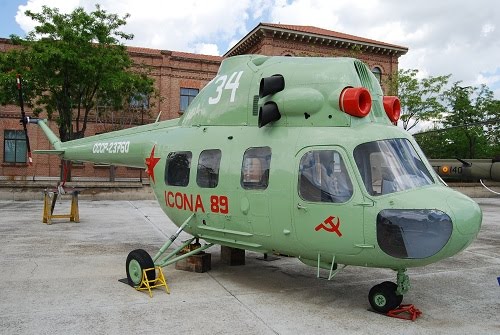 I love retro Soviet stuff, although the Stalin bus in St. Petersburg is going too far. This Mil Mi-2 Hoplite is just the ticket, incorporating drab green Soviet chic with a timeless hammer-and-sickle motif. Introduced as a military helicopter in 1965, it is still in wide use today for basic transport, forestry, air ambulance, and fire protection missions. Some developing countries, notably North Korea, still use these for military purposes.
Coming up tomorrow: biplanes!
The strange little airplane that became a movie star
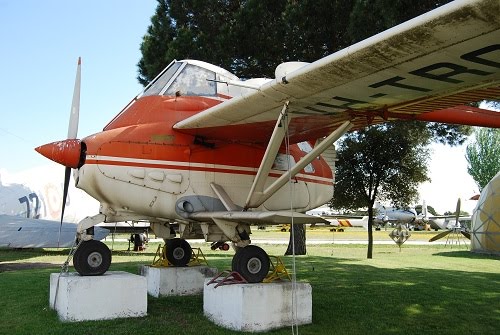 Does this little plane look familiar? Perhaps it would look more familiar all banged up and flying over the Australian outback with Mel Gibson in it? That's right, it featured in Mad Max: Beyond Thunderdome!
Introducing the Transavia PL-12 Airtruk, which in the first scene of the movie flies down out of the skies to attack Max as he's driving his disabled police car across the desert with the help of a team of camels. Jedediah the Pilot, played by Bruce Spence, knocks Max off the top of the car and steals the vehicle. Later in the movie Jedediah and Max team up. The pilot flies a group of kids to safety with Tina Turner and a bunch of leather daddies in hot pursuit. Max clears the way for them in a cool fight scene but is left behind, doomed to be the eternal outsider.
The PL-12 was introduced by the Australian company Transavia in 1966 for bush work such as search and rescue, ambulance duty, and agriculture and is a compact, highly maneuverable vehicle perfect for post-apocalyptic hijinks. It has a maximum speed of 195 km/hr, is 6.35 meters long, 2.79 meters high, with a wingspan of 11.98 meters. I've heard rumors that they're making another in the Mad Max series. I hope that's true, and I hope we get to see Jedediah the Pilot make a reappearance. He was always my favorite character. Hey Bruce Spence, if you happen to be googling yourself (no shame there, I do it all the time) could you tell us your memories of working with this cool plane?
Coming up tomorrow: helicopters and balloons!
Tuesday, 4 May 2010
Training the Luftwaffe in peacetime
 During the Spanish Civil War and World War Two, the Luftwaffe was the most feared air force in the world, but it came from very humble beginnings. After the Germans lost World War One, the Treaty of Versailles made them give up their air force. The rest of Europe didn't want any more Red Barons flying around!
Once Hitler came to power in 1933 he set about rebuilding Germany's military might. He wanted a strong air force, but couldn't have any planes and in the early years he was not yet powerful enough to defy the rest of Europe. So he ordered a fleet of these gliders to train his pilots. It's called the Aisa/Schneider SG-38 Schulgleiter ("training glider") and it trained a whole generation of German pilots on the basics of flight. They were considered sports equipment and therefore didn't fall under the ban of the Treaty of Versailles. This was a common trick of the early Third Reich, which had lots of "sports clubs" and "sports equipment" to train its young men for the next round of slaughter and ruin.
  Still, it's a pretty cool glider, even if it was used for bad purposes. It would take a fair amount of guts to go aloft in one of these! For those techies out there, it's 6.28 meters long, 2.43 meters high, and has a wingspan of 10.41 meters. It weighs 95.12 kilos empty. Maximum safe speed is 30 km/hr but one brave pilot got it up to 110 km/hr. The sign didn't say who that was but I'm betting he gave the Royal Air Force a bit of trouble.
These photos were taken at the Air Museum in Madrid, Spain. I've already posted some other photos from the Museo del Aire and will be posting every day this week, so tune in for some cool aircraft.
Tomorrow: The strange little airplane that became a movie star!
Monday, 3 May 2010
The Madrid Air Museum
 Last weekend the family and I visited Madrid's Museo del Aire. We were impressed by its collection of more than a hundred airplanes and helicopters, along with extensive displays of equipment, motors, etc. Needless to say, my four-year-old son loved this place. One of the curators told us it's the fifth biggest air museum in the world. I'm not sure who measures these things, but I'm willing to believe it. We took so many pictures that I'll be posting on the museum every day this week. So. . .on to the good stuff!
The cool retro jet pictured above is an F-86 Sabre and one of my favorites. Introduced into the U.S. Air Force in 1947 and serving with distinction in the Korean War, Spain bought 270 of them in 1955. It had a maximum speed of 1070 km/hr and this particular example was armed with six M2 Browning 12.7mm machine guns, a 20mm canon, and 24 MK4 "Mighty Mouse" air-to-air rockets. Here's a front view of a Saab AJ-37 Viggen "Thunderbolt". This Swedish plane was at the forefront of design when introduced in 1971. It could land with just 500 meters of airstrip thanks to strong landing gear and the ability to reverse the stream of the nozzle. It had a maximum velocity of 2124 km/hr. Armaments included a 30mm cannon, 2 Maverick and 4 Sidewinder missiles, and 24 Bofors rockets.
 The French Mirage III-E served in the Spanish Air Force from 1970-92. While Spain never used them in combat, other countries used them effectively in the Six-Day War, the Yom Kippur War, and the Falklands War. It had a maximum velocity of 2,350 km/hr and carried two 30mm cannons, 900 kg of bombs, one Matra R-530 and two Sidewinder air-to-air missiles.
 Besides aircraft, the museum has lots of other air-related machinery, like this searchlight dating to 1915. It saw service in the German army in the First World War and in the Spanish Civil War to protect a hydroplane base in Majorca.
Tomorrow: How the Germans trained the Luftwaffe without breaking the Treaty of Versailles, which said they couldn't have an air force!


 Posts
Posts


